Mission Briefing
By the end of this mission, you will be able to:
Explain what a relay module is and what problem it solves
Describe the difference between active-HIGH and active-LOW relay modules
Wire a relay module to the ESP32 safely
Turn a relay ON and OFF using code
Let's Get Started
The ESP32's pins can only handle a tiny bit of power — nowhere near enough to run a lamp, fan, or appliance directly. So how do smart plugs and home automation systems control full-powered devices? The answer is the relay.
Robo says: “A relay is like a tiny robotic hand that flips a real power switch for you, based on a signal from your code. Let's meet it.”
What Is A Relay?
A relay is an electrically-controlled switch. A small, safe signal from the ESP32 (just a few volts) controls an internal switch that can turn a completely separate, much higher-power circuit on or off — without the two circuits ever touching each other directly. This is what lets a tiny microcontroller safely control something like a lamp, fan, or appliance.
Active High Vs. Active Low
Important: many relay modules are “active LOW,” meaning they turn ON when the signal pin receives LOW, and OFF when it receives HIGH — the opposite of what you might expect from earlier lessons. Always check your specific module before wiring it up.
Safety First
In this unit, you'll always demo with a simple LED circuit, never a real mains-powered appliance. Working with mains voltage (the power from a wall outlet) is dangerous and should only ever be done by a qualified adult under proper safety conditions.
Wiring
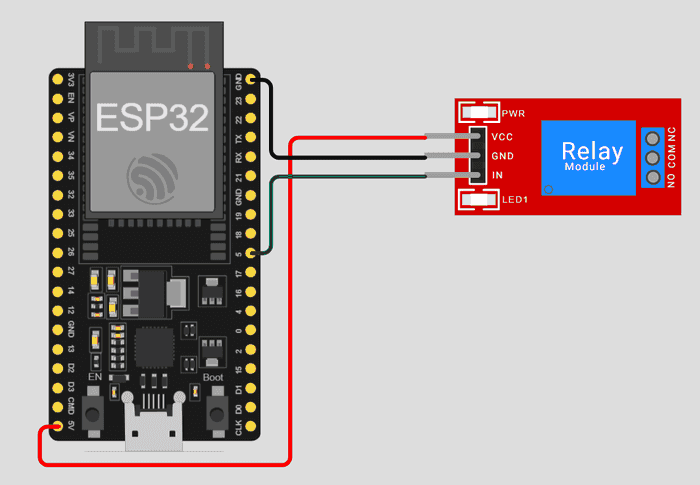
This lesson's circuit connects the relay like this:
VCC → 5V
GND → GND
IN → GPIO 5
Relay NO (normally open) → LED circuit for demo
Equipment
- ESP32
- Relay module (5V, single-channel)
- Jumper wires
- LED + 220Ω resistor (for safe demonstration)
Activity
Turn the LED ON and OFF via the relay.
Code
int relayPin = 5;
void setup() {
pinMode(relayPin, OUTPUT);
}
void loop() {
digitalWrite(relayPin, HIGH); // Relay ON
delay(2000);
digitalWrite(relayPin, LOW); // Relay OFF
delay(2000);
}
Did You Know?
- • Relays are what let a tiny “smart plug” you can buy online control a lamp or fan using just a phone app.
- • The clicking sound you sometimes hear from an appliance turning on and off is often literally the relay's internal switch physically snapping open or closed.
🔧 Try It Yourself
Run the code and observe the relay, then write down what you noticed:
Example: The relay clicked audibly every 2 seconds as it switched.
• Did you hear the relay click as it switched?
• Was your module active HIGH or active LOW?
int relayPin = 5;
void setup() {
pinMode(relayPin, OUTPUT);
}
void loop() {
digitalWrite(relayPin, HIGH); // Relay ON
delay(2000);
digitalWrite(relayPin, LOW); // Relay OFF
delay(2000);
}
Think About It
🤔 Discuss With a Partner or Write Your Answer
Why do you think it's safer to control a high-power appliance through a relay, instead of connecting the appliance's wiring directly to the ESP32?
Quick Recap: Fill In The Blanks
1. A relay is an electrically-controlled ________.
2. A relay lets a low-power signal control a completely separate, ________-power circuit.
3. A relay module that turns ON when it receives LOW instead of HIGH is called active ________.
4. In this unit, you will only ever demo relays using a safe ________ circuit, never a real appliance.
Match It!
Draw a line (or write the matching letter in the blank) to connect each word to its meaning.
Check Your Understanding
I can explain what a relay module is and what problem it solves
I can describe the difference between active-HIGH and active-LOW relay modules
I can wire a relay module to the ESP32 safely
I can turn a relay ON and OFF using code
Quiz Time!
Question 1: What problem does a relay solve?
🔍 Reveal answer (drag-select the blank space): B
Question 2: What does “active LOW” mean for a relay module?
🔍 Reveal answer (drag-select the blank space): B
Question 3: In this unit's lessons, what do you use to safely demonstrate a relay instead of a real appliance?
🔍 Reveal answer (drag-select the blank space): B
Challenge Zone
🏆 Level Up
Can you make the relay switch on and off in a specific pattern (like two short clicks, then a long pause) instead of a steady 2-second interval?
Robot Journal
Explain in your own words why a relay is needed to safely control something like a lamp or fan with a microcontroller.
Lesson Wrap-up
🤖 Robo Says
You just safely switched real power with code! Next up: Lesson 2 — you'll add a button so you can flip that switch yourself.